
Mono Grande
This piece first appeared in the Fredericksburg Standard in January 2026
My thanks to the United States doing whatever it is that they’re doing down in Venezuela for this week’s column. You see, I’ve been sick most of the Christmas holidays and am currently on my second round of antibiotics as the Z-Pak I took last week didn’t kill whatever it is that has been making my head feel like it’s in a vise and having me trying to cough up a lung every 10 to 15 minutes. As such, I haven’t exactly been thinking about what I’ll actually write this week. My column is due late Sunday afternoon and as of Friday evening I hadn’t given it much thought. I awoke Saturday to news that the US had taken control of Venezuela and then it dawned on me – I’ll write about the Mono Grande aka the Large Monkey.
Also known as the Bigfoot of Venezuela and de Loys’ Ape, the story of the Mono Grande began sometime between 1917 and 1920. It was then that Swiss geologist Louis François Fernand Hector de Loys and other members of the “Colon Development” were searching for oil around the River Tarra and Río Catatumbo. This mountain region of the Venezuela–Colombia Border was heavily forested, mostly unknown, and inhabited by less-than-friendly indigenous people. The expedition became lost and several members died from disease, were killed by Indians, or vanished into the jungle. The group came to rest on the banks of Tarra River one day when they were attacked by two unknown entities.
The creatures resembled monkeys but had no tail and walked upright. Each stood about five foot tall, were covered in reddish fur, and were thoroughly enraged. They shook bushes, brandished broken branches as clubs, then began throwing excrement in the direction of the men. Scared to death, the members of the expedition responded in the way anyone would in the early part of twentieth century would – they shouldered their rifles and fired. The group hit both animals. What the expedition believed was a male, escaped into the jungle. The female dropped dead where it was shot.
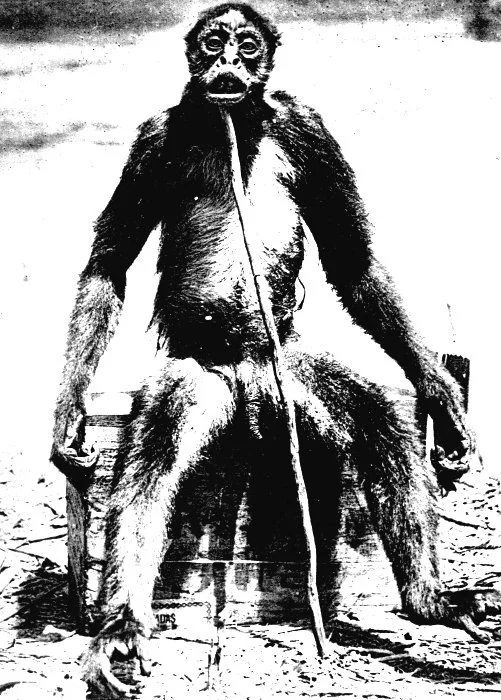
As the species was unknown to science, de Loys had the female photographed and tried to preserve the carcass and skull. The latter failed as both rotted. The group finally found their way out of the unexplored and returned to civilization (of the original 20 members only four survived.) Years later, in 1929, a French anthropologist named George Montandon was reviewing materials of the Colon Development and came across the only surviving picture of and a few notes about the ape that attacked the group. Montandon knew the animal pictured was not a monkey given its upright stature and, at roughly five foot tall, was almost twice the height on monkeys known to exist in South America. The creature had 36 teeth and carried all the characteristics of an ape. Montandon declared the animal Ameranthropoides loysi (Loys’ American ape form) in the Illustrated London News of June 15, 1929, and in another three scientific articles. Most scientists dismissed this “discovery” but did little in the way to actual disprove it.
In 1998, historians Pierre Centlivres and Isabelle Girod published an article suggesting accusing Montandon of fraud. They argued that Montandon was racist who held many completely outdated ideas about human evolution and used the de Loy discovery to push his own ideas. In 1999, the Venezuelan scientific magazine Interciencia published a letter sent in 1962 from a member of the expedition named Doctor Enrique Tejera to Guillermo José Schael the editor of the magazine Diario El Universal. That letter in part read, “This monkey is a myth. I will tell you his story…Mister Montandon said that the monkey had no tail. That is for sure, but he forgot to mention something, it has no tail because it was cut off. I can assure you this, gentlemen, because I saw the amputation… De Loys was a prankster and often we laughed at his jokes. One day they gave him a monkey with an ill tail, so it was amputated. Since then de Loys called him “el hombre mono” (the monkey man).”
Despite this, many claim the Mono Grande as real. Many scientists and cryptozoologist have argued that the picture doesn’t truly resemble spider monkeys of the area where it was shot. The “ape” in the picture has a different chest and hands, lacks the spider monkey’s pronounced underbite, and has a different forehead. Furthermore, the locals that inhabit that area have long told of ape like men in the area.
So, was de Loys’ discovery an actual ape? Well, given the amount of drugs I’m currently on, I’d say yes it was. Ask me again after I get better however and I might have a different idea.