Texas Buzzard Hunt
This piece first appeared in 2021 in the Fredericksburg Standard.
You can now hunt buzzards in Texas. Sort of.
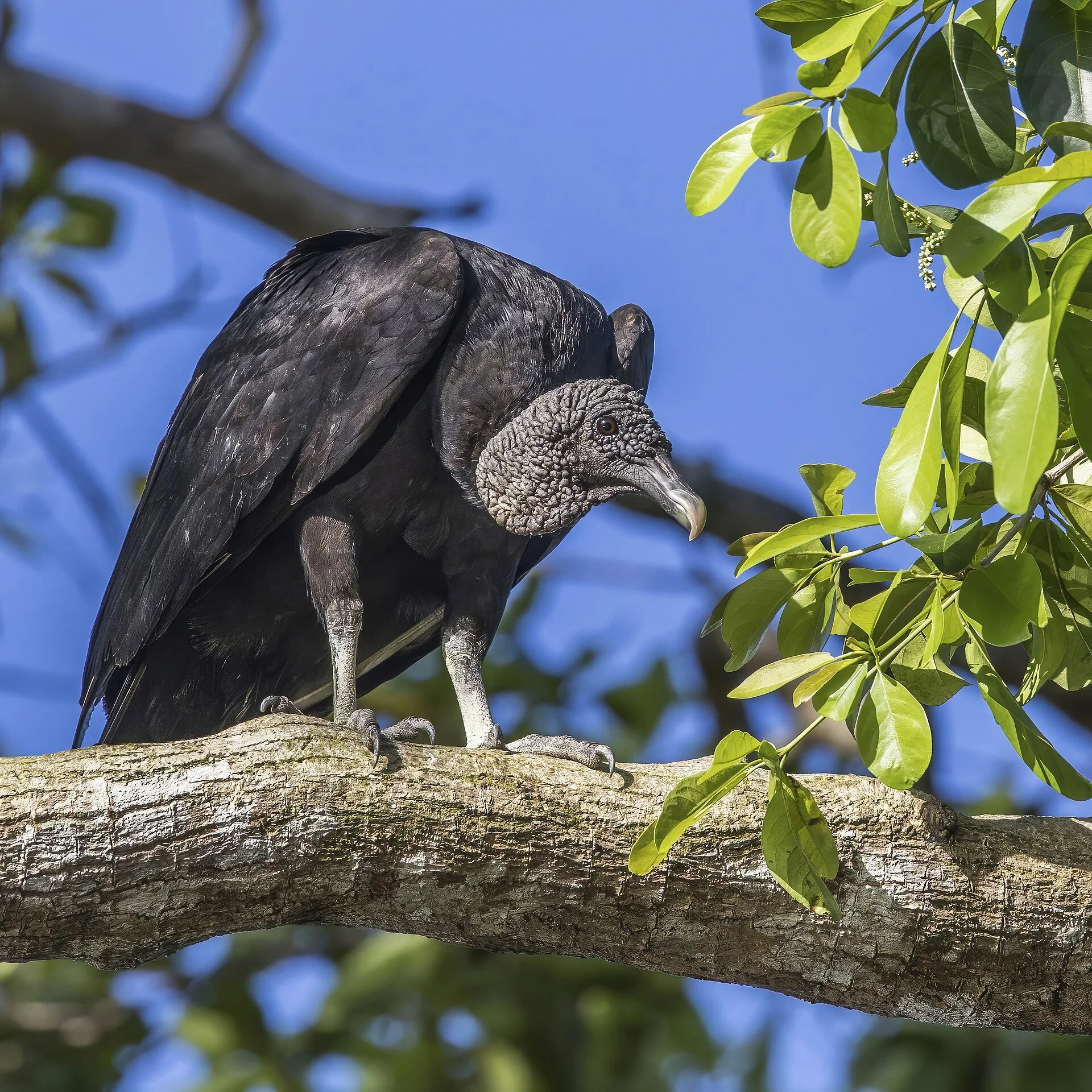
Two species of vultures — or buzzards as they are colloquially, yet incorrectly called — call Texas home:
the red-headed Turkey Vulture (Cathartes aura) and the black-headed Black Vulture (Coragyps atratus).
Both eat carrion but the latter is also a predator. It’s fond of eating eggs and killing and eating newborn
native game and livestock. It is because of their affection for livestock that they are now being targeted
by landowners.
Also known as a “carrion crow,” Black Vultures are easily identified by their black leathery head, gray
legs, short tail and glossy black plumage. They carry a wingspan of upwards of six feet and a weight of
nearly seven pounds.
Historically, they were restricted to South Texas but have moved north in the last decade, thanks to a
number of factors. These factors include the growth and abundance of dead food, both dead and alive,
found in landfills and our ever-growing road system (something’s gotta take care of all those dead
armadillos and possums on the road) and changes in livestock that now see year-round births.
As Mike Bodenchuk, director of Texas Wildlife Services (TWS), explained to the Texas Farm Bureau,
“Twenty, thirty years ago, black vultures were largely found in Texas south of I-10, but they’ve expanded
their range considerably up into the South Panhandle and other northern parts of Texas. So, we have a
lot more birds. We have them over a lot larger part of the state, and they’re very aggressive in terms of
competing with each other for food. There’s much more livestock loss today than there was 20 or 30
years ago.”
For years, ranchers have been complaining to the powers that be about the sudden upswing in the loss
of newborn livestock to Black Vultures and some have even provided evidence in the way of video of the
birds killing partially birthed livestock being killed by the birds as they exit the mother as proof.
Thankfully, the U.S. Fish and Wildlife Service (FWS) recently granted a permit to the Texas Wildlife
Damage Management Association (TWDMA) for Black Vulture management. Ranchers and landowners
can apply for sub-permits through TWS, which would allow them to remove up to five Black Vultures
each year.
The agency also suggests that folks try scaring the birds off through “auditory and visual dispersal
methods like lasers and propane cannons” before resorting to shooting them.
So, what do you do with a Black Vulture once you’ve shot it?
Bodenchuk said, “Using a vulture that’s shot as an effigy or using an artificial effigy — a body that looks
like a vulture with wings and a head, hung upside down in trees around the pasture — can help keep
vultures out of those areas. We recommend one effigy to about five acres. So, you couldn’t do this in a
large pasture, but if you have a confined area where livestock are giving birth, the effigies are useful as a
way of hazing vultures out of the area.”
Unfortunately — well, unfortunate for someone who would like to shoot a buzzard then mount it with
wings open above his fireplace because, ya’ know, women like that sort of thing and attracted to men
who do such things — one may not keep a Black Vulture after shooting it.
I know this because I called Jude Sandoval, District Supervisor, Texas Wildlife Damage Management
Service (TWDMS) in Kerrville, to ask him such.
“So, if I get the correct permit and successfully take a trophy-sized Black Vulture, can I have my
taxidermist mount it for me?”
“No.”
Bummer.
Bad for me. Good for landowners.
Like what you see? Want to keep the adventure going? Fire a PayPal or Venmo in my direction & you may get a shout out! Hot Tip: Include blog idea in the description…